What is GraphLens™?
A professional static analysis and architecture visualization tool designed to help Frontend Developers, Software Architects, Analysts, and QA Specialists master their Web projects’ architecture.


What is GraphLens™?
A professional static analysis and architecture visualization tool designed to help Frontend Developers, Software Architects, Analysts, and QA Specialists master their Web projects’ architecture.
Frontend Ecosystem
Built specifically for Angular. Seamlessly integrates as an extension with your VS Code and Open VSX compatible IDEs. Zero configuration required.
Security & Privacy
All processing is performed locally and without AI models – your project data never leaves your machine, providing deterministic, reproducible, and consistent results. Additionally, the extension’s bundle is scanned by VirusTotal.
Code Liquidity & CLS
GraphLens is built on the vision of Code Liquidity – ensuring your project remains accessible, comprehensible, and ready for rapid change to new business tasks. Master your architecture through the lens of the Code Liquidity Score™ (CLS).
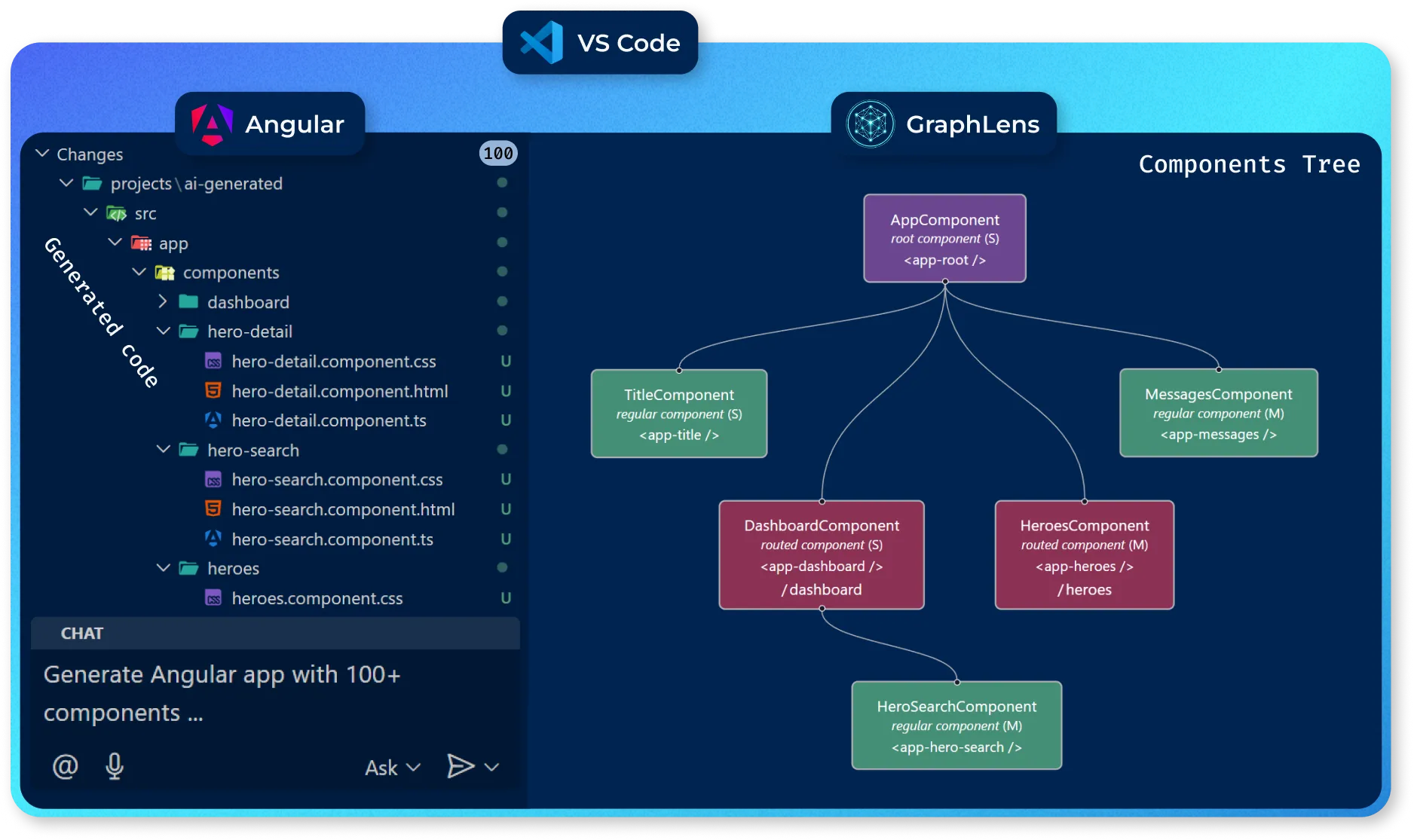
GraphLens acts as an explorer and visualizer for Angular projects directly within VS Code, helping you to:
Watch a 96-second deep dive into how GraphLens visualizes AI-generated code and helps you maintain architectural control.
In an ideal world, software evolution should unfold harmoniously, much like the Fibonacci sequence spiraling outward, where each new cycle of development builds naturally and predictably upon a solid structural foundation. However, in reality, scaling, shifting requirements, and continuous trade-offs lead to excessive software entropy – a chaotic labyrinth of invisible connections and hidden pitfalls, drastically increasing developer cognitive load and business costs.
We define “Code Liquidity” as a codebase’s ability to remain accessible, comprehensible, and ready for rapid, cost-effective change. Just as a highly liquid financial asset can be quickly converted into real value, liquid code can be easily, predictably, and cost-effectively transformed to meet new business requirements.
Explore this concept in our Core Philosophy.
This is especially relevant in the era of AI code generation: when advanced models can produce thousands of lines in seconds, maintaining human control over the resulting architecture becomes a critical condition for project success.
But Code Liquidity is just the tip of the iceberg – a resulting business metric that can be measured as precisely as financial liquidity. Beneath it lies a fundamentally new coordinate system for software development. In this system, architectural health is measured through software entropy metrics: the number, direction, and depth of connections between software entities, as well as their cohesion and coupling based on the project’s structure and external dependencies.
Today, GraphLens acts as a powerful static analysis and visualization tool that brings the hidden geometry of architecture to light. It automatically gathers information across your Angular workspace and transforms complex architectural relationships into a structured, cognitively accessible form.
Visualizing the software architecture is only the first step. The next fundamental milestone is to build a strong theoretical foundation and conduct empirical measurements to fully digitize software architecture. By turning visual graphs into precise, actionable metrics – culminating in the Code Liquidity Score™ (CLS) – GraphLens will help teams not only comprehend their system’s current state, but actively manage entropy, regain architectural control, and guarantee the highest level of code liquidity.
Read more about the philosophy behind Code Liquidity, the impact of AI on software entropy, and the origins of GraphLens in recent publications:
The current focus is transforming GraphLens from a plain visualizer into a comprehensive architectural metric engine. Here is a high-level overview of our trajectory:
Explore full Roadmap